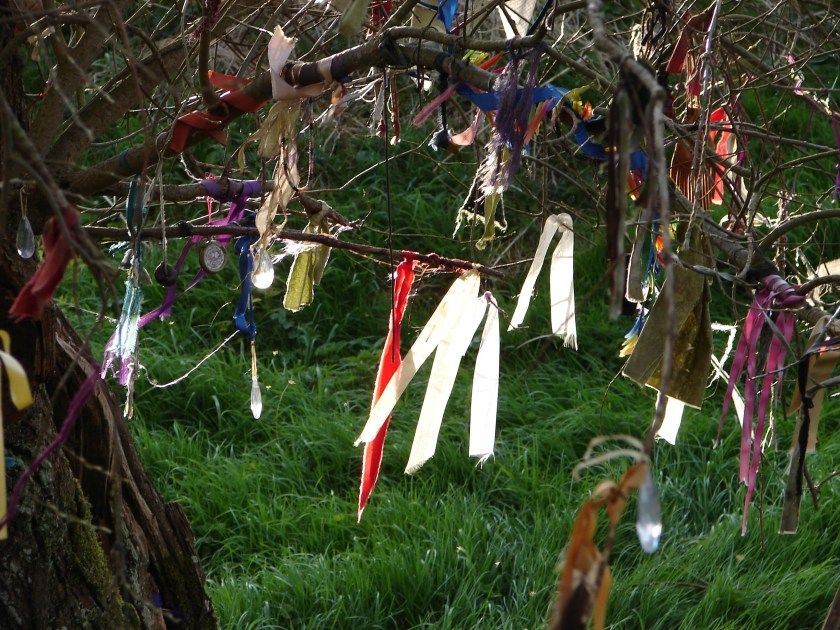
In a place with a history that dates back 5,000 years but which is visited by thousands of people every year can there be any mystery left? The answer is yes. Nearby Avebury is a fascinating, enchanted place. In the near distance, Silbury Hill dominates the skyline, but there is a small spring that nestles not far away from these eye-catching sites. This is Swallow Spring, and as the photo below shows, many consider it to be a place of healing.
Still a place of healing?
Scattered around in other secluded places are similarly decorated trees, bearing gifts and messages, perhaps a tradition that dates back – how long? Five thousand years perhaps, who knows. In its own way, a mystery as great as those linked to Avebury and Silbury Hill.
Much has been written over the years concerning the Druids, but the truth is that there are few references to them in ancient sources. Altogether, only about eight or nine pages of references to the Druids have come down to us, written by a mix of admirers and detractors, with some just being pure fiction. Some historians even question whether they existed at all, others whether if they had simply been called priests, they would have received the prominence their name has attracted.
But the fact is, they have stood out. Still, we definitely know of only one Druid by name, although others by inference. The one clearly referenced Druid is Divitiacus, a friend and ally of Caesar, and a Chief (princeps) of the Aedui tribe of Gaul, and named so by Marcus Tullius Cicero, who spent some time with him in Rome.
He is described as a eulogist and as being acquainted with the system of nature which the Greeks call natural philosophy, and he used it to predict the future by augury and inference. He addressed the Senate in 61 BC, testifying to his powers of oratory and presumably the fact he could speak Latin. His plea for military assistance against the incursions of the Germanic tribes into the territory of the Aedui was rejected, though apparently, he went away thinking he had been successful. So, what were the powers and authority of the Druids? Most commentators believe that although they had priestly functions, this was only one facet of their role in Celtic society. Peter Beresford Ellis in his book The Druids, likens them to the Brahims of India, the highest caste in Hindu society. While they delivered a religious function, they also had roles as philosophers, judges, astronomers, and prophets. And apparently as rulers in some cases, but not necessarily so. Interestingly, his brother Dumnorix was a joint ruler of the Aedui, (apparently not an unusual arrangement, as there are similar examples of joint rulership amongst other Celtic tribes). With good reason as it turns out, Dumnorix is not so trusting of Julius Caesar, who describes himself as a friend of Divitiacus. As he had good reason to since Divitiacus seems to have sold out most of Gaul to Caesar before he disappeared from the historical record around 54 BC.
Looking down the ages, today we might judge him as a traitor, whilst his brother, Dumnorix we might infer was a freedom fighter, since Caesar holds him as a hostage, until he briefly escapes. He is then caught and killed, and his tribe, the Aedui rise in a revolt that takes Caesar four years to quell.
The record does not state whether Dumnorix was a Druid, but neither fit the later Roman stereotype of priests cutting mistletoe and human sacrifice which begins to appear in the historical record as the Roman commentators begin to view the Druids as the “enemy”.
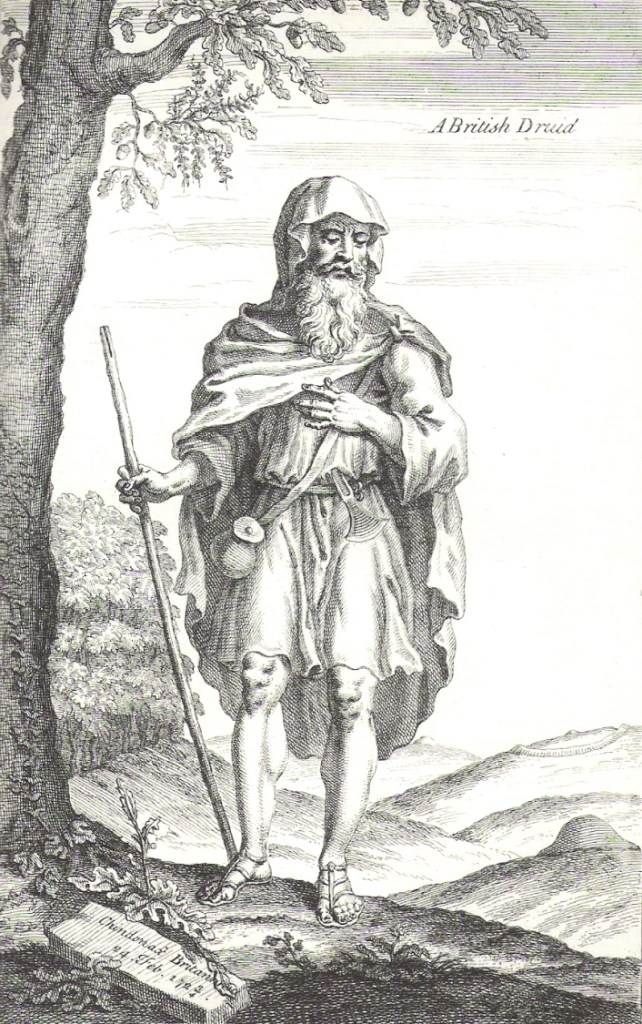
Romans murdering a Druid by Thomas Pennant (1726-1798)
The origins of the Druids is complex and unclear. So, I shall start at the other end with their demise, which, while still questionable, is at least clearer. According to the Roman writer and historian Tacitus, they were wiped out when a Roman army led by Suetonius Paulinus attacked their base on the island of Mona, (Anglesey, or in Welsh Ynys Môn, just off the Welsh coast). The truth is more complex, and there is plenty of evidence to show the Druids lasted into the Christian period, most notably in Ireland. But Tacitus provides a good starting point and a notable tale, though of course he was no friend of the Druids, and it was in his interest to glorify the achievements of Paulinus. This is how he describes the battle that occurred, and the massacre that occurred afterwards.
On the shore stood the opposing with its dense array of armed warriors while between the ranks dashed women in black attire like the Furies, with hair dishevelled, waving brands. All around, the Druids, lifting up their hands to heaven and pouring forth dreadful imprecations, scared our soldiers by the unfamiliar sight, so that, as if their limbs were paralysed, they stood motionless, and exposed to wounds. Then urged by their general’s appeal and mutual encouragements not to quail before a troop of frenzied women, they bore the standards onwards, smote down all resistance, and wrapped the foe in the flames of his own brands. A force was next set over the conquered, and their groves, devoted to inhuman superstitions, were destroyed. They deemed it, indeed, a duty to cover their altars with the blood of captives and to consult their deities through human entrails.
There is an area adjacent to the Menai Strait called the Field of Blood, which may be the place described. It is not relevant here, but while Paulinas was busy in Anglesey, Boudicca was letting rip around what is today London and Colchester, avenging her rape and that of her two daughters.
This could not of course have been the end of the Druids, since many would have been elsewhere, especially in Ireland where the Romans never set food. Nevertheless, it might have been the beginning of the end, significantly weakening the power of the Druids.
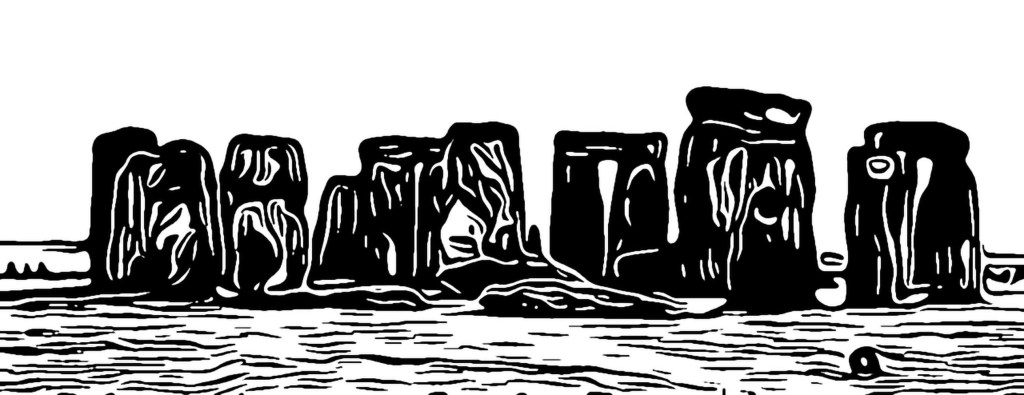
One of the best known sites in the world and still one of the most enigmatic. For centuries people have speculated as to its purpose and who its builders were. Of recent times there have been many big discoveries about Stonehendge but if anything they just further add to its mysteries.
One of the lead archeologists who has revealed many of these discoveries is Professor Mike Parker-Pearson of University College London. These include:
Durrington Walls: Probably the village that housed the people who contructed Stonehenge. But mysteriously built on top of the original village is a construction that required as many as 300 huge wooden posts, evenly spaced 5m apart in a ring almost 450m across. And yet, more mysteriously, within a maximum of 50 years this monument had been decommissioned, its posts removed and their sockets filled in. What, why?
The Bluestones: These are the smaller stones at Stonehenge. It is assumed that originally there were about 80 of them but now only 43 remain. They each weigh between 2 and 5 tons and came originally from Prescilli in Wales. They were placed there during the third phase of construction at Stonehenge indicating a gap of some 500 years. How were they moved and why?
Stonehenge was moved from Wales: In early 2021 Parker-Pearson annouced he had indistputable evidence that Stonehenge was first built in Wales and then moved to its current site. Interestingly this fits in with an ancient myth about Stonehenge, first recorded 900 years ago, which tells of the wizard Merlin leading men to Ireland to capture a magical stone circle called the Giants’ Dance and rebuilding it in England as a memorial to the dead. This account is by Geoffrey of Monmouth who is also mentioned in The Wisdom Of Rhiannon series due to his reference that Caesar’s invasion was a failure. Further evidence comes from the fact that the diameter of the Welsh site is 110 metres which is identical to the ditch that encloses Stonehenge. It is aligned on the midsummer solstice sunrise, just like the Wiltshire monument.

 The Wisdom of Rhiannon