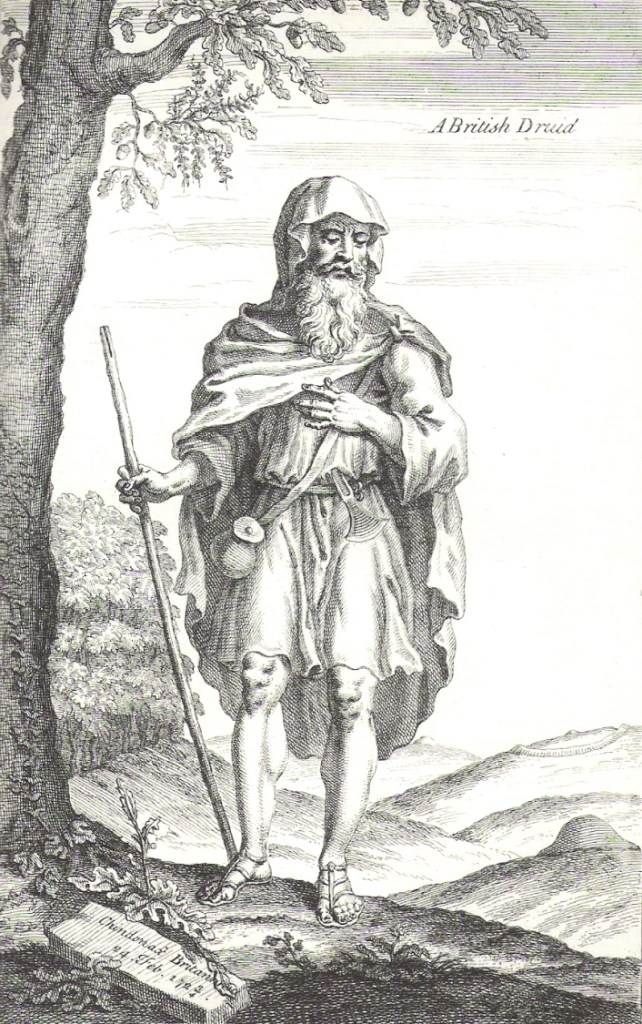
Much has been written over the years concerning the Druids, but the truth is that there are few references to them in ancient sources. Altogether, only about eight or nine pages of references to the Druids have come down to us, written by a mix of admirers and detractors, with some just being pure fiction. Some historians even question whether they existed at all, others whether if they had simply been called priests, they would have received the prominence their name has attracted.
But the fact is, they have stood out. Still, we definitely know of only one Druid by name, although others by inference. The one clearly referenced Druid is Divitiacus, a friend and ally of Caesar, and a Chief (princeps) of the Aedui tribe of Gaul, and named so by Marcus Tullius Cicero, who spent some time with him in Rome.
He is described as a eulogist and as being acquainted with the system of nature which the Greeks call natural philosophy, and he used it to predict the future by augury and inference. He addressed the Senate in 61 BC, testifying to his powers of oratory and presumably the fact he could speak Latin. His plea for military assistance against the incursions of the Germanic tribes into the territory of the Aedui was rejected, though apparently, he went away thinking he had been successful.
So, what were the powers and authority of the Druids? Most commentators believe that although they had priestly functions, this was only one facet of their role in Celtic society. Peter Beresford Ellis in his book The Druids, likens them to the Brahims of India, the highest caste in Hindu society. While they delivered a religious function, they also had roles as philosophers, judges, astronomers, and prophets. And apparently as rulers in some cases, but not necessarily so.
Interestingly, his brother Dumnorix was a joint ruler of the Aedui, (apparently not an unusual arrangement, as there are similar examples of joint rulership amongst other Celtic tribes). With good reason as it turns out, Dumnorix is not so trusting of Julius Caesar, who describes himself as a friend of Divitiacus. As he had good reason to since Divitiacus seems to have sold out most of Gaul to Caesar before he disappeared from the historical record around 54 BC.
Looking down the ages, today we might judge him as a traitor, whilst his brother, Dumnorix we might infer was a freedom fighter, since Caesar holds him as a hostage, until he briefly escapes. He is then caught and killed, and his tribe, the Aedui rise in a revolt that takes Caesar four years to quell.
The record does not state whether Dumnorix was a Druid, but neither fit the later Roman stereotype of priests cutting mistletoe and human sacrifice which begins to appear in the historical record as the Roman commentators begin to view the Druids as the “enemy”.
 The Wisdom of Rhiannon